On December 24th 2018, the ESA satellite XMM-Newton was pointing at a galaxy 240 millions light years away from Earth, located in the direction of the galactic South Pole, named GSN 069.
A new kind of cosmic signal was about to be collected by XMM-Newton.
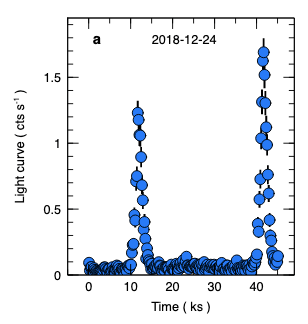
The X-ray signal, originating in the nucleus of the galaxy GSN 069, that was detected by the XMM-Newton telescope on 24 December 2018.
Astronomers were stunned in observing such sharp, intense variations of
X-ray light happening in so short time scales. The two bursts of X-rays lasted about one hour, and were separated by about nine hours.
From Miniutti et al. 2019, 1Nature 573, 381
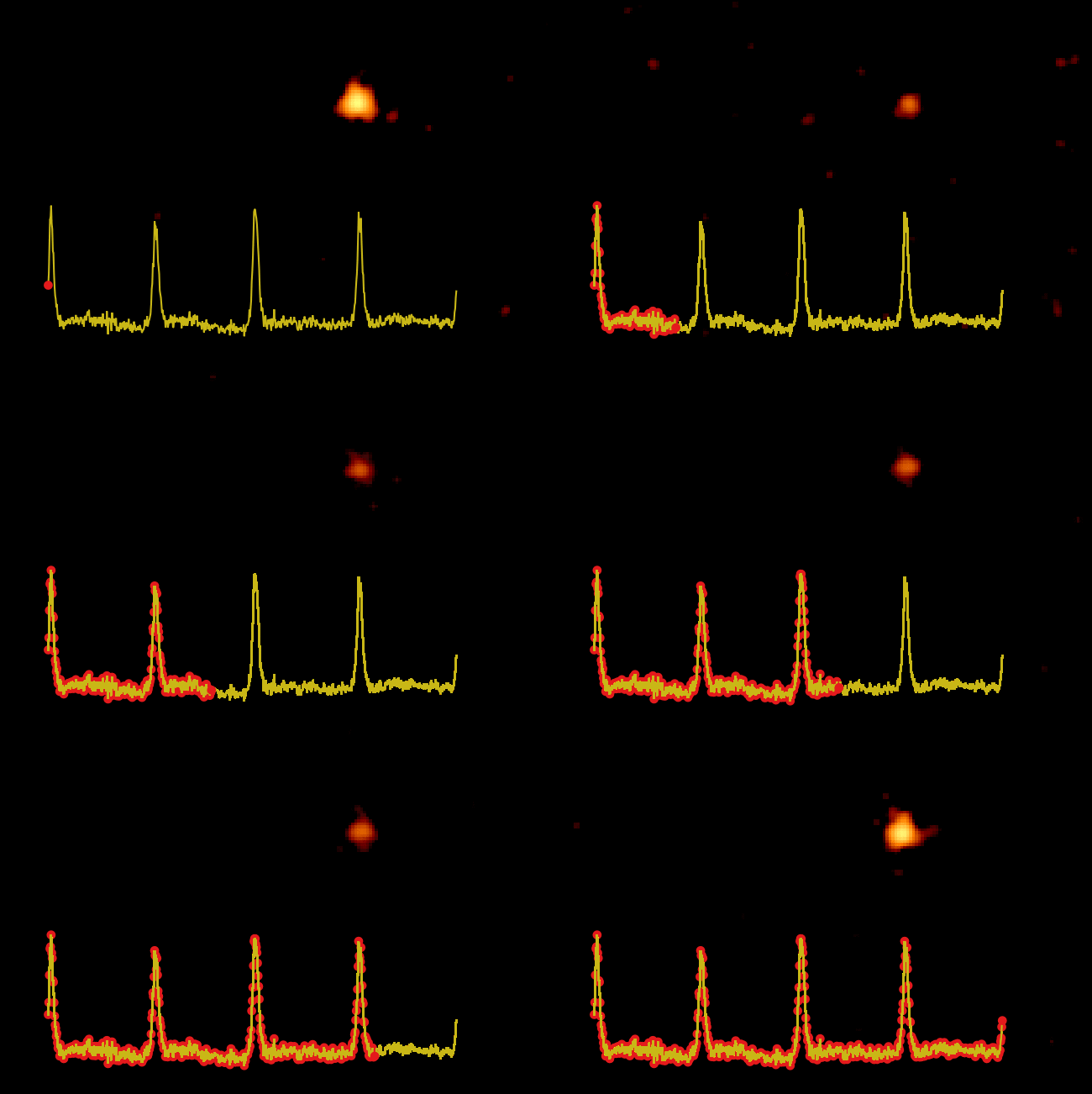
This is a real X-ray image (speed up 4000x), with a real X-ray light curve, of the nucleus of the galaxy GSN 069, taken with the XMM-Newton space observatory on 16 and 17 January 2019.
Never before such intense, sharp, recurrent eruptions of X-ray photons had been observed
from the nucleus of any galaxy.
Quasi-periodic Eruptions had been discovered.
➜ If you want to know more, check out the Nature blog entry written by Giovanni Miniutti, the QPE discoverer.
➜ You can check the discovery of QPEs as covered by the press here.
Short after the discovery of QPEs, a similar signal was identified in archival XMM-Newton observations of the galaxy RX J1301.9+2747.
 Margherita Giustini