My research involves three broad main topics:
Black Hole Winds, X-ray Quasi Periodic Eruptions, and X-ray missions.
Black Hole Winds
Supermassive black holes have a fundamental role in our Universe. They reside in the nuclei of most – if not all – the main building blocks of our Universe: galaxies.
The role of supermassive black holes in shaping the formation and evolution of galaxies is the subject of active investigation by astrophysicists from all around the globe.
Surprisingly, lots of matter is pushed out from the vicinity of supermassive black holes, either driven by magnetic forces or by radiation. The impact of black hole winds into the galaxy can be important.
Black holes and galaxies are possibly deeply intertwined by means of a mutual exchange of energy, or feedback, and part or most of this feedback might be provided by supermassive black hole winds.
I investigate cosmic feedback in the form of winds driven by radiation in the proximity of supermassive black holes in distant galaxies.
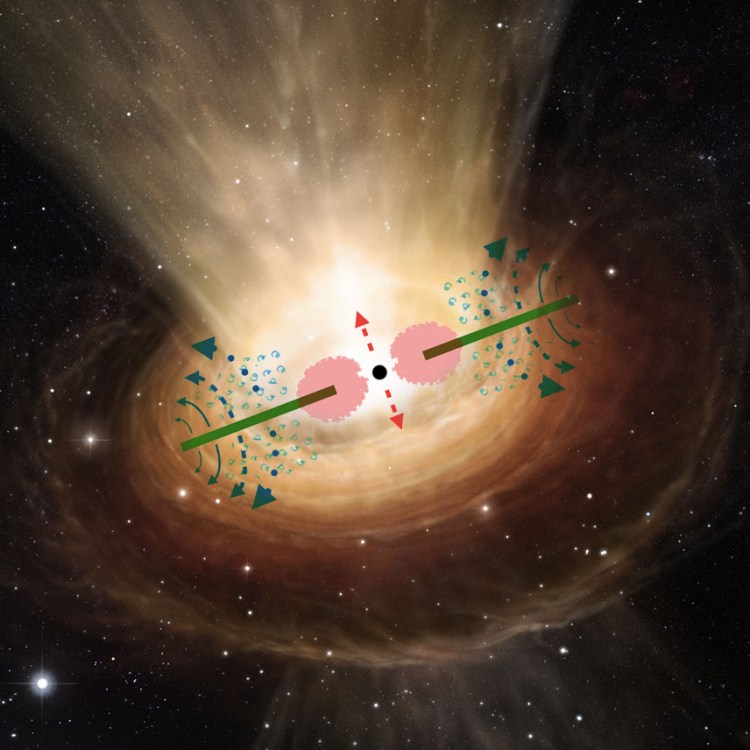
Together with Daniel Proga, we proposed a global scheme for the inner (sub-parsec) accretion and ejection flow around supermassive black holes in active galaxies.
Radiation-driven accretion disk winds are added to the AGN scheme.
See Giustini & Proga 2019, A&A 630, 94
A free version of the article is available at: https://arxiv.org/abs/1904.07341
Some talks about black hole winds driven by radiation pressure:
X-ray Quasi Periodic Eruptions
I am part of the team led by Giovanni Miniutti (CAB), who discovered
X-ray Quasi-periodic Eruptions (QPEs) in the nucleus of the galaxy GSN 069.
QPEs are unprecedented cosmic signals: extremely regular and sharp
increases in X-ray brightness, that last about one hour and repeat every about nine hours.
The signal originates close to the central supermassive black hole of the galaxy, but the physical explanation behind this new phenomenon is not known yet. It could involve orbital motions of a second body, or physical instabilities of the very inner accretion flow, perhaps magnetic in nature.
In order to try to understand better what is causing QPEs, new observations of GSN 069 with the largest telescopes around the world and in orbit around the Earth are planned in the next future.
In the meanwhile, the search for QPEs in other galactic nuclei continues.
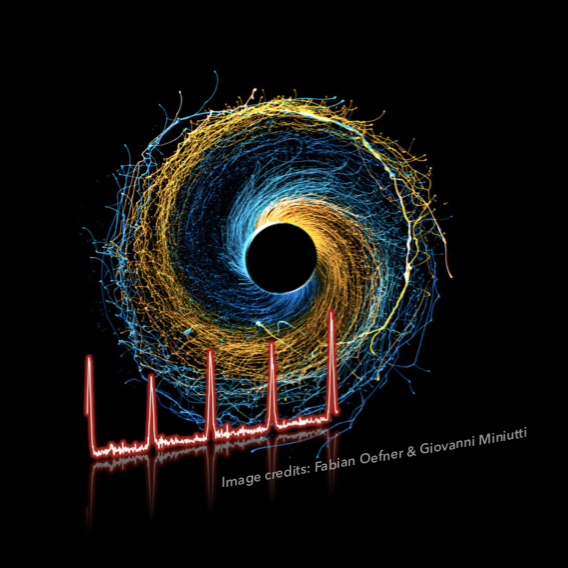
X-ray Quasi-periodic Eruptions have been discovered in the nucleus of the galaxy GSN 069
The search for X-ray QPEs
in other galactic nuclei continues.
See Miniutti et al. 2019, Nature 573, 381
A free version of the article is available at:
https://arxiv.org/abs/1909.04693
X-ray missions
I was scientifically born as an X-ray observer, and while many things have continuously changed during my scientific career, the constant has been the use of X-ray data.
I am an expert user of ESA’s satellite XMM-Newton, whose data I have been analysing for the past 20 years with undiminished passion and enthusiasm; I visited ESAC for the first time in 2008 to collaborate in the X-ray study of a supermassive black hole variable wind; then I came back during 2012-2014 as Research Fellow in Space Science in the XMM-Newton SOC; now I work at ESAC, in the CAB (CSIC-INTA). Five times during my life the telescope has moved toward the region of the sky I was recommending, delivering data of photons that had traveled millions of light years in order to reach my computer and my mind.
Since February 2024, I am a member of the XMM-Newton Users Group. That means that you can contact me for any problem, question, suggestion, about the largest collecting area X-ray telescope placed in orbit by humans so far.
During my career I have contributed to the development of past and future X-ray missions.
I am member of the the X-IFU Consortium of the future ESA’s Large Mission newAthena,
and I contribute to the newAthena Scientific Working Group
“Feedback in local AGN and star forming galaxies”.

I routinely use the data collected with the largest X-ray telescopes built by humans
I am a member of the scientific community of the future ESA mission newAthena, and member of the XMM-Newton Users Group
Happy posing in front of the COSMOS field with my favourite satellite, XMM-Newton
Here you can find a list of my scientific articles.
Here you can find some of my talks and presentations.
Here you can find my Curriculum Vitae.
 Margherita Giustini