We all belong to the Cosmos, and the Astro-lectures are here to remind us.
We happen to part of a very beautiful Universe, but we often don’t think much about it, busy with our daily terrestrial lives.
What happens in the Universe affects what happens on Earth, and knowing more about our Universe can make our daily lives much more pleasant. Being aware of the place we occupy in the Cosmos — the relative sizes of cosmic bodies, the distances between them — can help us relativize the daily problems we may have, and can give us a much broader view on our own life.
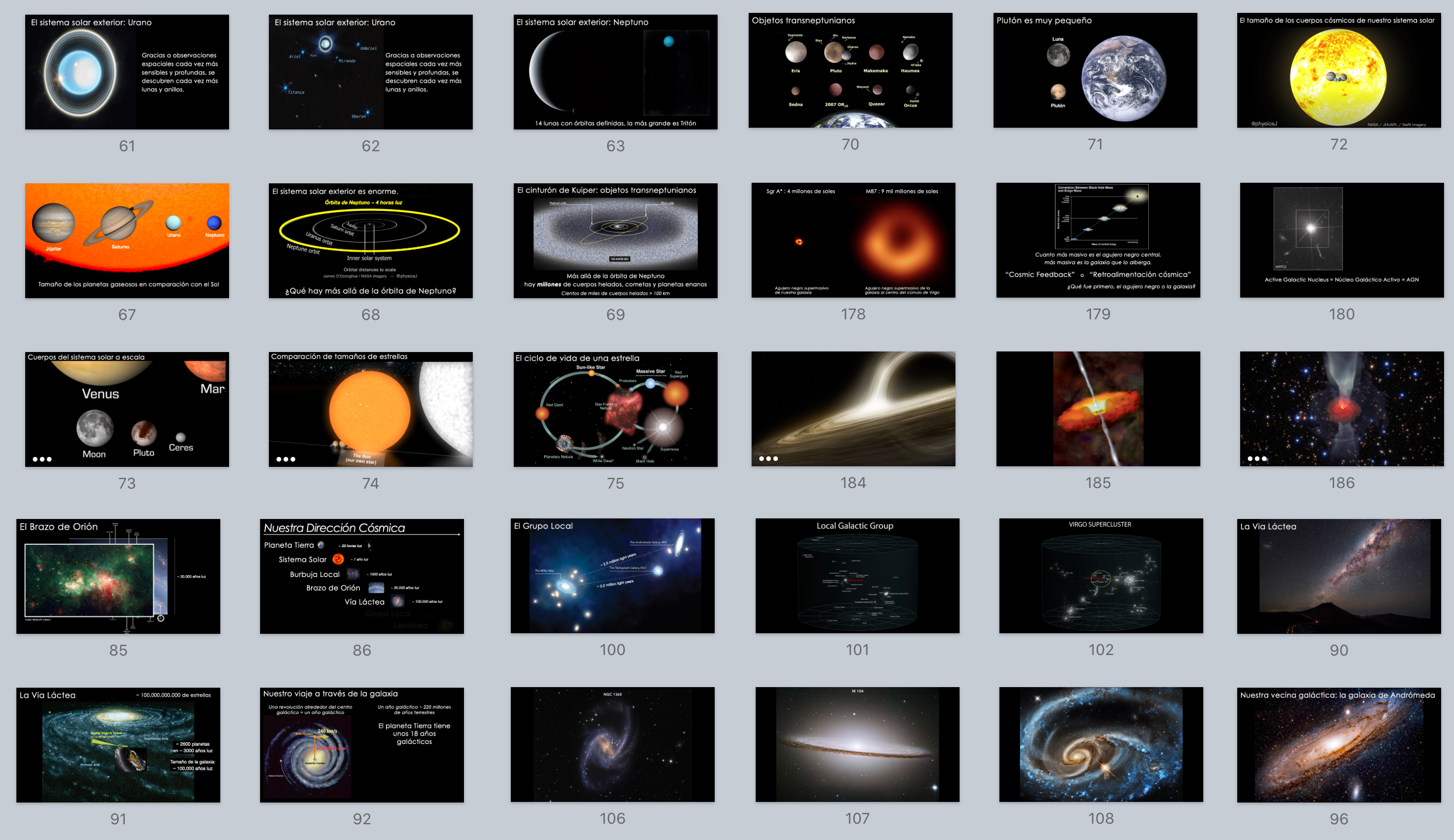
It is good to know how we move in the interstellar space, around the Sun and around the center of the Galaxy, and toward the Virgo Cluster of galaxies. It is good to know what a galaxy is, which kind of galaxies are out there in the Cosmos, and how they are intimately connected to the supermassive black holes they harbour at their centres. It is good to know that there is a supermassive black hole at the center of our own Galaxy, and to understand how it behaves. It is good to know how precious our Earth biosphere is, and to understand the series of Cosmic phenomena that may put our lives in danger. It is good to know how far humanity can go, when unites into a common vision, a shared goal.
I observe the Universe as a job, and I use to say: “The Universe never ceases to amaze me”. I spend most of my life in awe toward the Universe, and I would like to share at least part of this Cosmic awesomeness with you.
The Astro-lectures are a unique chance to expand your vision of the Universe we all live in, by interacting one-to-one with a professional astronomer and astrophysicist.
The Astro-lectures are simple, made of basic concepts, and are suitable for people of any age and educational background. I have given talks, seminars, lectures, public speeches in many countries and to many different audiences, and the reactions have always been extremely positive — from satisfied to enthusiastic.
The Astro-lectures are a special opportunity to:
- Enlarge and soften your point of view on many problems of the daily terrestrial life;
- Expand the realm of your thoughts and of the conversations with your peers;
- Discover your hidden passions by resonating with Cosmic phenomena.
They are a great resource for children and teenagers, but really, for any human with a live curiosity for the Nature we happen to belong to.
I offer one-hour interactive sessions for the equivalent price of a night out, a dinner at the restaurant1. This will include an open question+answer session at the end of the Astro-lecture. Meetings happen online and can be held in English, Italian, Spanish, or Portuguese.
Give your kids (and your friends, and yourself!) a Cosmic eyesight:
Book an Astro-lecture!

Detailed Astro-lectures menu:
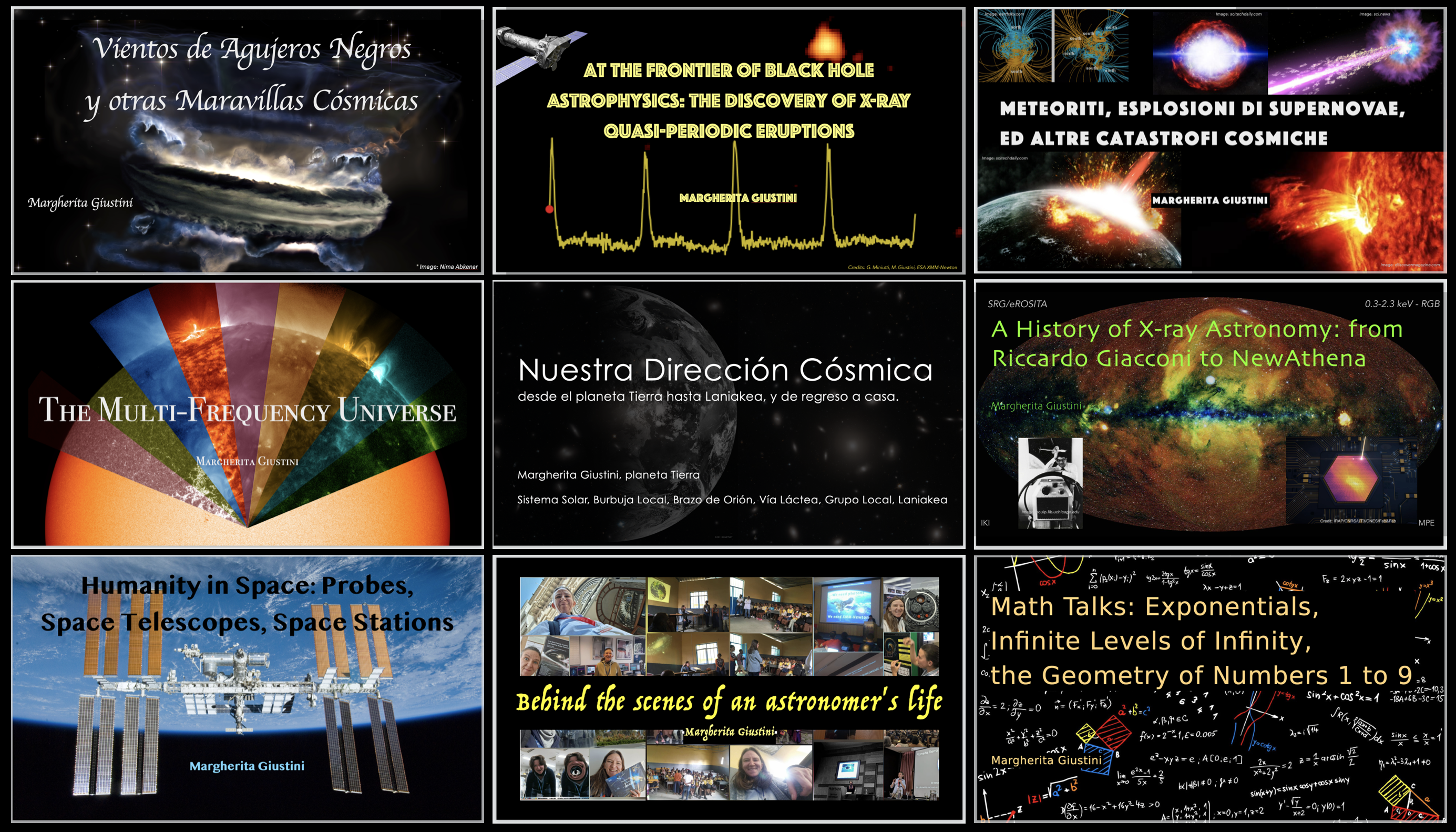
Our Cosmic Direction
“Our Cosmic Address” is the quintessential astro-lecture, recommended for everyone regardless of age, mood, or level of interest. In this session, we will journey from the Earth-Moon system to the Milky Way, the Virgo cluster of galaxies, and beyond: we will discover the Cosmic objects that surround us, those that contain us, and those toward which we are moving. The primary goal of this astro-lecture is to understand where we are placed in the Universe through a realistic representation of Cosmic dimensions and distances.
Keywords: Earth, Moon, Solar System, Orion Arm, Milky Way, Galaxies, Virgo Cluster, Cosmic Superstructures, Laniakea.
Black Hole Winds and Other Cosmic Wonders
From mathematical abstractions in the minds of a few humans, black holes have become protagonists in the history of our Universe. At the center of every galaxy lies a supermassive black hole, and the existence of both the galaxy and the central black hole appears to be intimately connected. Not everything that approaches a black hole is captured. In fact, much of the approaching matter is often swept away in the form of winds, relativistic jets, tsunamis. In this astro-lecture, after donning “multi-frequency glasses”, we will travel to the vicinity of the event horizon of supermassive black holes at the centers of distant galaxies — first passing near the supermassive black hole at the center of our Milky Way Galaxy. We will discover that the Universe is far more imaginative than all of us humans put together.
Keywords: Black Holes, Galaxies, Event Horizon, Accretion Disk, Black Hole Winds, Relativistic Jets, Cosmic Feedback.
Meteorites, supernova explosions, and other cosmic catastrophes
The Cosmos we live in isn’t exactly friendly: it’s in fact a very hostile environment for human bodies, and it can pose major threats to our planetary safety. In this astro-lecture, we’ll discover together the space hazards that can affect life on planet Earth: from meteorites, cosmic rays, solar flares, massive stellar explosions, the merger of white dwarfs or neutron stars, and even the activation of the supermassive black hole at the center of our Galaxy. The primary goal of this astro-lecture is to understand how precious Earth’s biosphere and all the life it supports are at a Cosmic level.
Keywords: Earth, Magnetic Field, Magnetosphere, Solar Flares, Aurora, Cosmic Rays, Supernovae, Compact Objects, Meteorites, Black Holes.
At the Frontier of Black Hole Astrophysics: The Discovery of Quasi-Periodic X-ray Eruptions
This is the story of how twelve hours of observation with the largest X-ray telescope ever built by humans serendipitously generated an entire field of scientific research, which inspired hundreds of minds across the planet to propose previously unimagined models, devise new strategies for gathering new observations, and build new telescopes. In this astro-lecture, I will take you behind the scenes of the discovery of X-ray Quasi-Periodic Eruptions (QPEs), in which I had the privilege of participating, and the new frontiers of contemporary black hole astrophysics that this new cosmic phenomenon has opened up.
Keywords: Modern Astrophysics, Serendipity, X-ray Telescopes, Quasi-Periodic Eruptions, Black Holes, Tidal Disruption of Stars, Galaxies.
A History of X-ray Astronomy: From Riccardo Giacconi to NewAthena
The X-ray Universe is not accessible from Earth because our atmosphere absorbs the X-rays arriving from the Cosmos: the history of X-ray astronomy is therefore inextricably linked to space science. In this astro-lecture, I will share some details of the evolution of X-ray astronomy: from the first experiments conducted by Professor Riccardo Giacconi in the USA, to the realization of the existence of galactic and extragalactic black holes, to the large satellites built by the major space agencies (ESA, NASA, JAXA) with their adventures and misadventures, to the satellites under construction and in development. Together, we will discover a myriad of high-energy Cosmic phenomena that decisively influence the formation and evolution of the Universe we live in; phenomena made accessible to human knowledge thanks to the strenuous cooperation of scientists and engineers from nearly every country in the world in the face of political, economic, and physical challenges and unforeseen circumstances. Space is a difficult environment.
Keywords: X-ray astronomy, the Energetic Universe, Plasma, Space Science, Black Holes, Space Telescopes, Active Galactic Nuclei, Space Catastrophes, X-ray Rainbows, Microcalorimeters.
The Multi-Frequency Universe
Human physiology allows minimal access to the information contained in the Universe. In fact, unlike many other terrestrial animals, we can only perceive a tiny portion of the electromagnetic spectrum: what we call the “rainbow”. How does our view of the Universe change when technology allows us to expand our perception to frequencies other than that of the rainbow? In this astro-lecture, we will discover this together, observing planets in the solar system, planetary nebulae, supernova remnants, galaxies and galaxy clusters, from the very low frequencies of radio waves to the very high frequencies of gamma rays, through infrared, ultraviolet, and X-rays.
Keywords: Rainbow, Radio Waves, Microwaves, X-rays, Infrared, Ultraviolet, Gamma Rays.
Humanity in Space: Probes, Space Telescopes, Space Stations
What is the history of humanity’s relationship with space? How does it affect the rest of planetary life? What happens to a satellite that stops working? In this astro-lecture, we’ll journey through the history of the development of aerospace technology, from the first rockets used for X-ray astronomy, leftovers from World War II, to atmospheric balloons, to the first satellites and space stations. We’ll arrive at the present day, with an overview of the current state of nations with space agencies, the large number of scientific satellites in operation, their primary purposes, and their serendipitous scientific and technological discoveries; and the current state of commercial space operations and their impact on human scientific activity and the physiology of many terrestrial life forms.
Keywords: Space Science, Satellites, Space Stations, Space Telescopes, Light Pollution, Atmospheric and Stratospheric Pollution, Space Debris, Van Allen Belts, Serendipity, Dung Beetle, Tardigrade.
Math Talks: Exponentials, Infinite Levels of Infinity, the Geometry of Numbers 1 to 9
This astro-lecture has a more mathematical, arithmetic, and geometric focus than the others; this doesn’t mean it isn’t part of our Universe. Starting from a story passed down for almost a millennium, as old as the game of chess, we’ll have a chat about exponential phenomena. We’ll discover how life, in the long run, is much more exponential than linear, especially in the case of very important phenomena. We’ll then move on to a real dilemma for the human mind — something we can’t dwell on for long without descending into physiological madness: the concept of infinity, and its various levels. With simple examples, we’ll touch on the first levels of higher infinity, to grasp what can be solidly and confidently grasped about this fascinating and dangerous concept. We’ll close our cosmic-mathematical chat with a light and meditative geometric-arithmetic digression. We will discover that behind simple mathematical operations (addition, multiplication, power) lie curious geometric relationships between the numbers 1 to 9.
Keywords: Chess and Grains of Rice, Exponential, Linear, Infinity, Higher-Order Infinites, Aleph, Georg Cantor, Arithmetic, Geometry.
Behind the scenes of an astronomer’s life
What’s the life of an X-ray astronomer really like? In this astro-lecture, I’ll share the educational and professional journey that led me to become an astronomer with three out of four petals of my personal Ikigai already in place, and actively fighting for the fourth. We’ll talk about unexpected journeys to distant lands, bureaucracy, meritocracy, great Professors, satellites breaking apart in orbit, and paths closing and opening like spirals. I’ve been observing the Universe for almost twenty years, and the Universe never ceases to amaze me.
Keywords: Astronomy, Astrophysics, Space Science, Italy, Spain, Netherlands, United States, Japan.
If you’re curious to learn more about the Universe that contains us all (and that we all contain!), if you have some time and resources to invest, please, don’t hesitate to contact me.
Let’s find the first space-time hole in our calendars,
and let’s meet in the Cosmos!
You can contact me using the two forms below:


…thank you infinite, infinite of a higher order!
Direct link to the fundraising campaign
- The value of an Astro-lecture is typically the equivalent of a dinner out at a restaurant, but I’m more than happy to accept smaller or larger amounts, just proportionate to how much you feel/are able to contribute, at this specific moment, to my personal Ikigai. Everything is more than welcome. ↩︎
 Margherita Giustini